The 5 Stages revisited: where does your practice sit?
The framework we built from the 2018 findings, what’s shifted since, and five questions to ask of your own practice.

Every SMSF practice is on a path. The question is whether you’re choosing it or drifting along it.
In 2019, we took the 2018 Future of SMSF findings and turned them into a practical framework: the 5 Stages of an SMSF Business. It was built to help practices see where their SMSF business sits today, what typically holds a practice back at each stage, and what it takes to move to the next one.
Seven years on, it’s worth revisiting, because the sector around it has changed, and the 2027 research will test whether the stages still hold.
The five stages
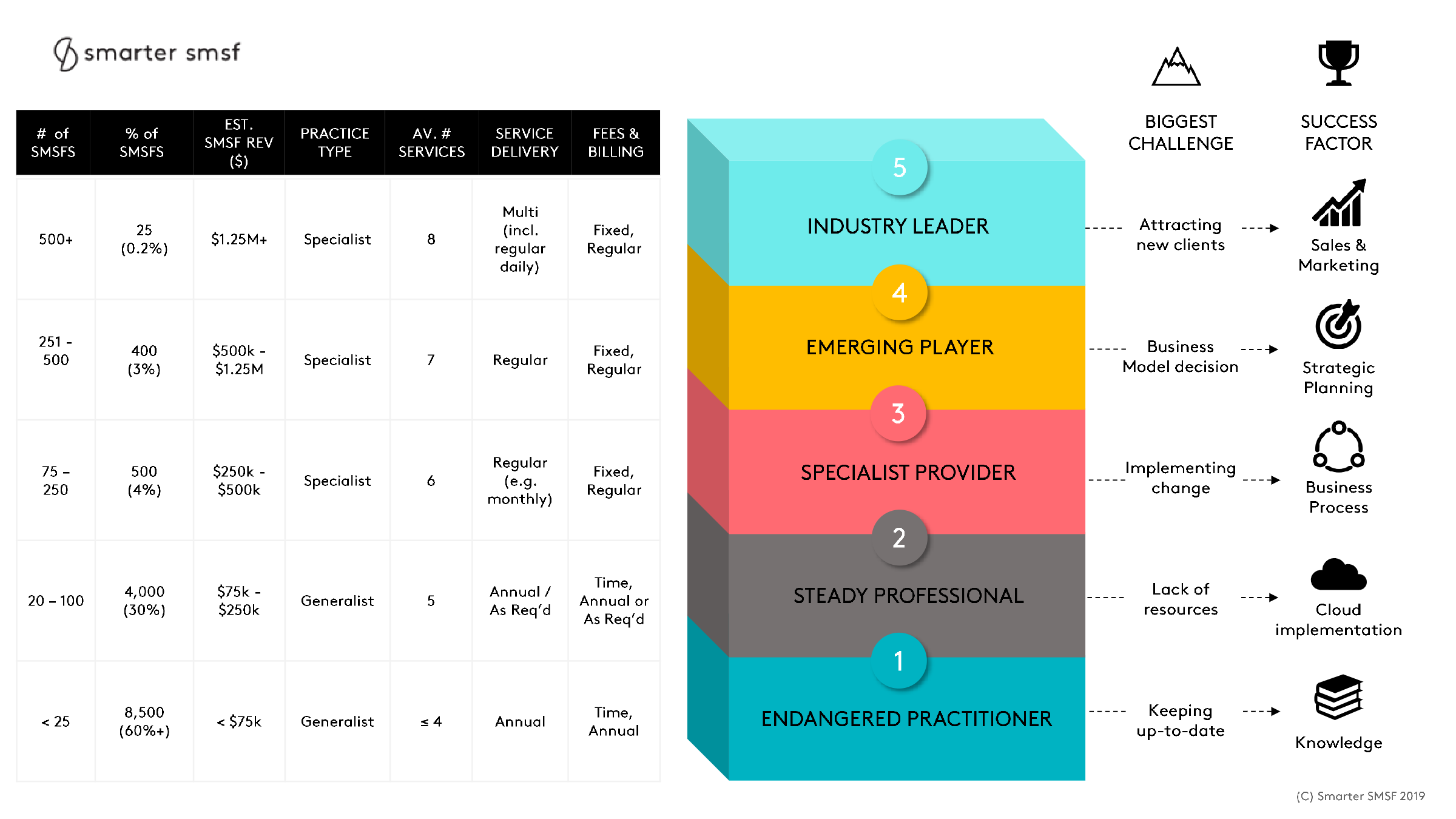
And the detail behind each stage:
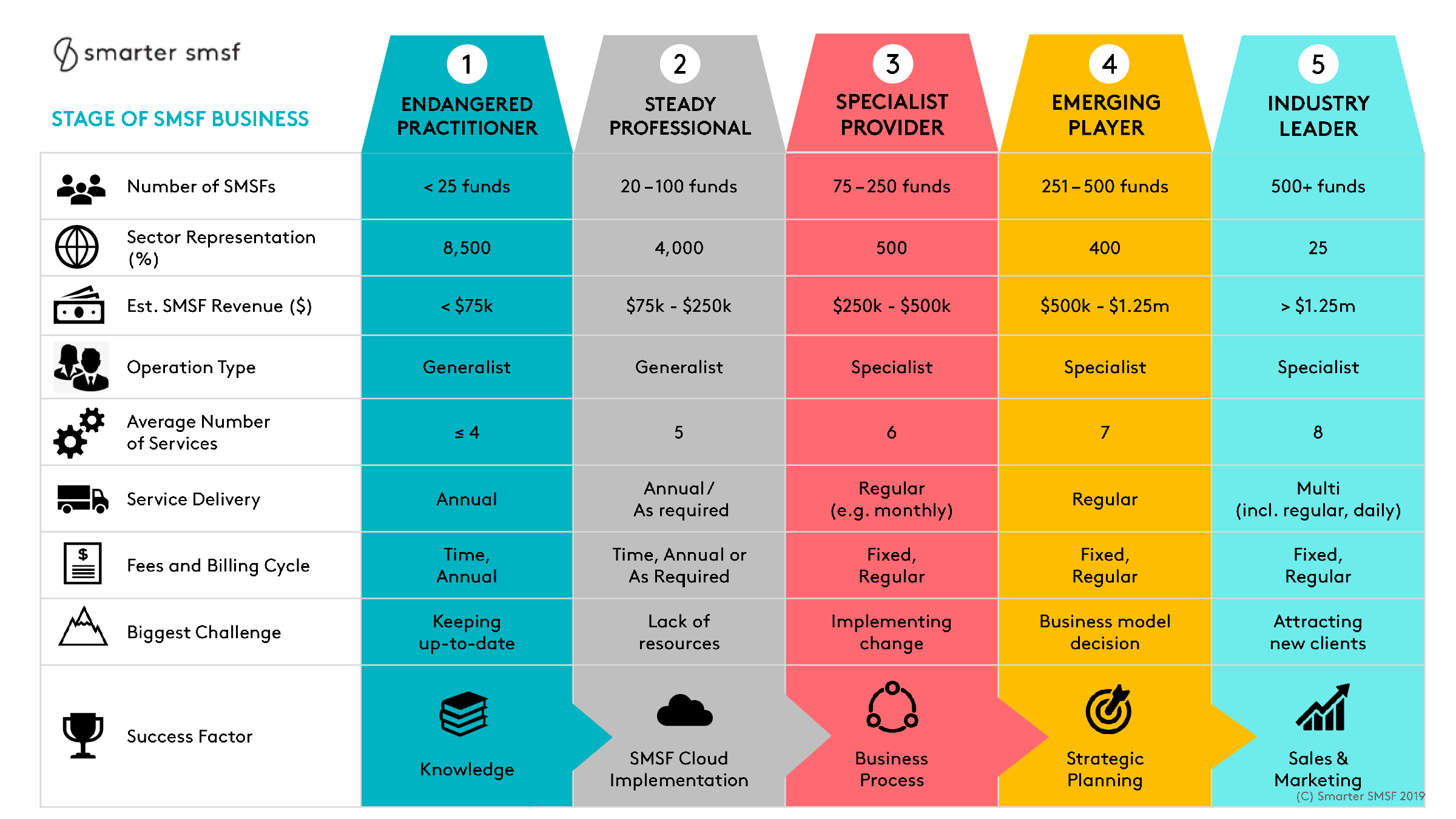
The stages aren’t a judgement. Plenty of practices choose to stay small, and do it well. The risk is in standing still without deciding to.
What’s shifted since 2019
The bottom of the pyramid is still wide. For 2023–24, around 53% of tax agents lodging SMSF returns lodged 10 or fewer, and the median agent lodged just nine. Most of the sector’s providers are still at Stage 1, carrying the full weight of SMSF compliance across a handful of funds.
The top is more concentrated. Audit shows it most clearly: 11% of SMSF auditors now complete 75% of all SMSF audits. Scale is winning where the work can be standardised.
The pressure on Stage 1 has gone up. “Keeping up to date” was the biggest challenge for an endangered practitioner in 2019. Since then, Division 296 has become law, payday super has started and the advice and licensing debate has rolled on. That’s a lot to absorb across 10 funds.
The opportunity is back. New fund establishments have roughly doubled in five years, and around half of the members joining new SMSFs are now under 45. That’s a different client, with different expectations about how often they hear from you and how they see their fund.
The question AI raises
Here’s what I want the 2027 research to test.
The original stages were built on a simple assumption: scale buys you capability. More funds meant more resources, which meant better technology, more regular service and better pricing.
AI may break that link. If a 60-fund practice can deliver the regularity, insight and service of a Stage 4 firm, the stages stop being about size and start being about how you run the business.
Or AI widens the gap, because the firms with scale adopt it fastest. We don’t know yet. That’s exactly why we’re asking.
Five questions to ask of your practice
- How many funds, and by design? Is your number of SMSF clients a strategy, or an outcome of who walked in the door?
- How often do clients hear from you? Annually at lodgment, or regularly through the year?
- How do you price? If you’re still billing on time, what happens to your revenue as automation takes the time out?
- Who really knows your software? Is there someone in your practice who knows your most important platform inside out?
- What’s your plan for AI? Not whether you’ll use it, but where it will change your process, your people and your pricing.
If those questions are uncomfortable, you’re not alone. They were uncomfortable in 2018 too.
Final word
The 2027 report will revisit the 5 Stages with fresh data, showing how practices have moved since 2018 and whether the path between stages has changed. Wave 1, Your practice today, captures exactly what we need to place practices on that path, and once the report is out, we’ll release tools so you can benchmark your own practice against the results.
Wave 1 opens on Monday 16 November. Make sure your practice is in the picture.
We believe smart people learn together. Here’s to choosing your path, not drifting along it.
Aaron Dunn
CEO and Founder of Smarter SMSF and author of the Future of SMSF reports since 2014. SMSF Association Chair Award 2023, recognised for his outstanding contribution to the SMSF sector, having made significant contributions to sector growth and sustainability.
More from the series
New technology, new reform, old thinking?
Technology and reform are hitting the SMSF sector at the same time. Why the research is back for 2027.
Report partnersWhy we’re inviting report partners
How the 2027 partnerships work, who they suit, and the rules that keep the findings independent.
From the researchWhat 2014 and 2018 told us
The calls we got right, the ones we got wrong, and what the sector still hasn’t changed.
Put your practice in the picture
Wave 1, Your practice today, opens Monday 16 November. Anonymous, with a free report for everyone who takes part.